

Disclosure: This article contains affiliate links. If you purchase through our links, we may earn a small commission at no extra cost to you. Our rankings are based solely on clinical evidence — not affiliate relationships.
Finding the best OTC laxatives for constipation is not as simple as choosing the first product you see on a pharmacy shelf. With dozens of options available, including fiber supplements, stimulant laxatives, osmotic laxatives, and stool softeners, many people make their decision based on brand recognition, advertisements, or recommendations from friends and family.
The problem is that not all laxatives work the same way. They use different mechanisms to relieve constipation, and the quality of clinical evidence supporting them varies significantly. Some products are backed by strong research and medical guidelines, while others have much more limited evidence.
Constipation affects an estimated 16% of adults in the United States, making over the counter laxatives some of the most commonly purchased nonprescription medications. Chronic idiopathic constipation, often abbreviated as CIC, affects an estimated 8% to 12% of the US population. Many people try OTC treatments before consulting a healthcare professional, but they may end up choosing products that are not supported by the strongest available clinical evidence.
This guide ranks the major OTC laxatives for constipation using evidence from three authoritative sources. The goal is to help readers understand which products have the strongest scientific support for effectiveness and safety.
- Rao & Brenner (2021): A landmark systematic review in the American Journal of Gastroenterology that screened 1,297 studies and analyzed 41 qualifying clinical trials from 2004–2020.
- AGA–ACG Clinical Practice Guideline (2023): The most up-to-date joint guideline from America’s two leading gastroenterology societies, using the gold-standard GRADE methodology.
- Mayo Clinic: For patient-friendly safety guidance and laxative categories.
By the end, you will know exactly which products have the strongest evidence, which ones to avoid, and how to choose the right option for your situation.
⚡ Quick Answer: Best OTC Laxatives for Constipation — Ranked by Evidence
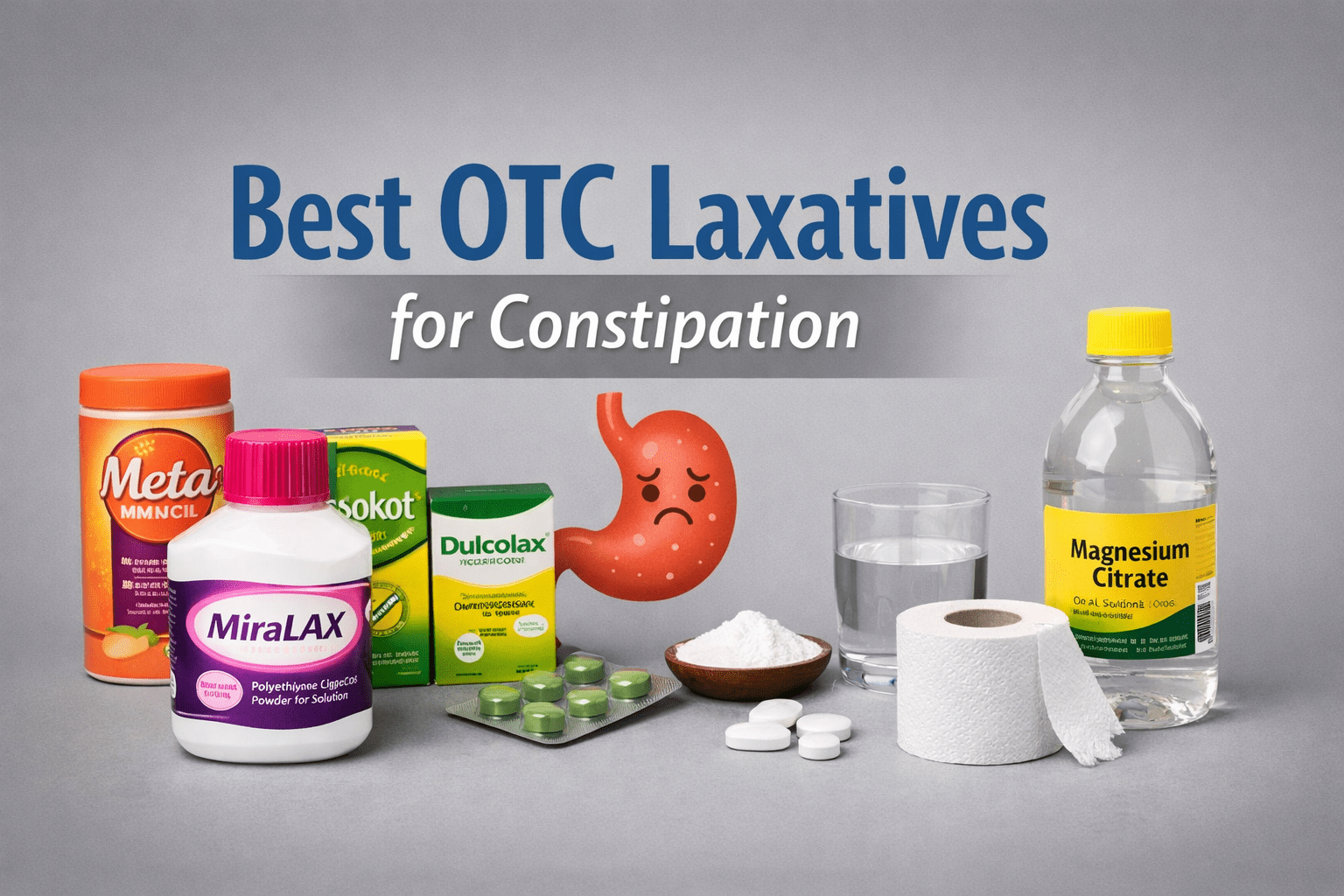
- MiraLAX (PEG) — Grade A + Strong recommendation (2023); best overall for chronic constipation
- Dulcolax (Bisacodyl) — Grade B + Strong recommendation (2023); best for rescue/fast relief
- Senokot (Senna) — Grade A + Conditional recommendation (2023); fast-acting, short-term only
- Metamucil (Psyllium) — Grade B; best for daily long-term fiber support
- Magnesium-based — Grade B; gentle and effective for occasional use
- Kiwi & Prunes — Grade B; best natural food-based options
- Colace (Docusate) — Grade I; insufficient evidence for constipation

What Is Constipation? Simple Signs to Watch For
According to Mayo Clinic, constipation means you are having fewer bowel movements than usual, or your stools are hard, dry, and difficult to pass.3 Most doctors define constipation as fewer than three bowel movements per week.
Common symptoms include:
- Straining to pass stool
- Hard or lumpy stools
- Feeling like your bowel never completely empties
- Bloating and abdominal discomfort
Common causes include low fiber intake, inadequate fluid intake, physical inactivity, certain medications, and aging. Women experience constipation more often than men, and it becomes more common after age 60.
Before reaching for a laxative, Mayo Clinic recommends trying lifestyle changes first: eat 25–31 grams of fiber daily, drink 8–10 glasses of water per day, and exercise regularly.3 For more on how dehydration drives constipation, see our guide: Does Dehydration Cause Constipation?
How Do We Know Which Laxatives Work? Understanding the Evidence
Not all laxative claims are equal. The 2021 Rao & Brenner review graded each OTC treatment using a clear system:
| Grade | What It Means | Plain English |
|---|---|---|
| Grade A | Good evidence from multiple well-designed trials | ✅ Strongly recommended |
| Grade B | Moderate evidence; fewer or smaller trials | ✅ Recommended |
| Grade C | Poor evidence from weak trials | ⚠️ Not routinely recommended |
| Grade I | Not enough data to make any recommendation | ❌ Insufficient evidence |
The 2023 AGA–ACG Guideline used the GRADE system with two recommendation strengths:
- Strong recommendation — Most patients should use this. Benefits clearly outweigh risks.
- Conditional recommendation — A good option for many patients, but the decision should be made with your doctor based on your individual situation.
Important note on ranking: In the Quick Answer above, Bisacodyl is ranked #2 and Senna #3 — even though both received Grade A in the 2021 review. This is because the 2023 AGA–ACG Guideline gave Bisacodyl a strong recommendation, while Senna received only a conditional recommendation. Under the more rigorous GRADE framework, Bisacodyl’s evidence is considered more reliable for short-term use.
Best OTC Laxatives at a Glance: Full Comparison Table
| Product | Type | 2021 Grade | 2023 AGA–ACG | Onset | Best For | Buy |
|---|---|---|---|---|---|---|
| MiraLAX (PEG) | Osmotic | Grade A ✅ | Strong, Moderate certainty | 24–72 hrs | Chronic constipation | Check Price |
| Dulcolax (Bisacodyl) | Stimulant | Grade B ✅ | Strong, Moderate certainty (short-term) | 6–12 hrs oral; 15–60 min suppository | Rescue/occasional | Check Price |
| Senokot (Senna) | Stimulant | Grade A ✅ | Conditional, Low certainty | 6–12 hrs | Short-term relief | Check Price |
| Metamucil (Psyllium) | Fiber/Bulk-forming | Grade B ✅ | Conditional, Low certainty | 12–72 hrs | Daily prevention | Check Price |
| Milk of Magnesia | Osmotic/Magnesium | Grade B ✅ | Conditional, Very low certainty (MgO) | 6–12 hrs | Gentle overnight | Check Price |
| Magnesium Citrate | Saline/Osmotic | Grade B ✅ | Not separately graded | 30 min–6 hrs | Fast occasional relief | Check Price |
| Colace (Docusate) | Stool Softener | Grade I ❌ | No recommendation issued | 12–72 hrs | Not recommended for constipation | — |
1. MiraLAX (Polyethylene Glycol) — Best Overall OTC Laxative
🏆 Evidence Rating: Grade A (2021) | Strong Recommendation (2023 AGA–ACG)
What Is It and How Does It Work?
MiraLAX contains polyethylene glycol 3350 (PEG), an osmotic laxative. It works by drawing water into the colon, softening stool and making it easier to pass. According to Mayo Clinic, osmotic laxatives “draw water into the colon to allow easier passage of stool.”3 PEG is not absorbed by the body, so it stays in the gut and works locally — making it one of the safest options for regular use.
What Does the Research Say?
PEG is the most thoroughly studied OTC laxative available. In the 2021 systematic review, PEG received a Grade A recommendation — the highest possible rating — based on 9 clinical trials.1 It is the only OTC laxative supported by both short-term and long-term clinical study data.
The 2023 AGA–ACG Guideline confirmed this with a strong recommendation with moderate certainty of evidence — making PEG the only OTC constipation treatment to receive a strong GRADE recommendation for chronic daily use.2
Pros and Cons
| ✅ Pros | ❌ Cons |
|---|---|
| • Highest evidence grade (Grade A) • Only OTC laxative with long-term RCT data • Safe for daily chronic use • No dependency or tolerance risk • Tasteless; mixes into any drink |
• Slow onset (24–72 hours) • Not suitable for urgent or immediate relief • May cause bloating or loose stools at high doses |
Who Should Use It?
PEG is the best choice for people with chronic constipation — ongoing, recurring difficulty with bowel movements. It is also safe for elderly adults and pregnant women under physician guidance. See our full guide: Immediate Constipation Relief for Elderly Adults at Home.
📦 Our Pick: MiraLAX Laxative Powder — Unflavored, dissolvable in any beverage. Available in multiple sizes.
Onset: 24–72 hours | Use: Daily long-term | → Check Price on Amazon
2. Dulcolax (Bisacodyl) — Best for Rescue Relief
🏅 Evidence Rating: Grade B (2021) | Strong Recommendation for Short-Term Use (2023 AGA–ACG)
What Is It and How Does It Work?
Bisacodyl is a stimulant laxative that activates the muscles lining your intestines, triggering contractions and pushing stool through. According to Mayo Clinic, stimulant laxatives “trigger rhythmic contractions of intestinal muscles” to move stool along.3 It is available in both tablet and suppository form.
What Does the Research Say?
Bisacodyl and its close relative sodium picosulfate both received Grade B recommendations in the 2021 review — a significant upgrade from Grade C in the 2005 Ramkumar & Rao review.1
The 2023 AGA–ACG Guideline issued a strong recommendation with moderate certainty of evidence for bisacodyl for short-term use (up to 4 weeks) or as rescue therapy.2 This is notably stronger than the conditional recommendation given to senna under the same framework — which is why Bisacodyl ranks #2 overall despite its Grade B in the 2021 review.
Pros and Cons
| ✅ Pros | ❌ Cons |
|---|---|
| • Strong 2023 AGA–ACG recommendation for short-term use • Evidence grade upgraded from C (2005) to B (2021) • Fast onset: 6–12 hrs oral; 15–60 min suppository • Available in tablets and suppositories |
• Strong recommendation applies to short-term/rescue use only • High rate of cramping and diarrhea at initial doses • Not recommended for daily long-term use |
📦 Our Pick: Dulcolax Stimulant Laxative Tablets — 5 mg bisacodyl tablets; also available as suppositories for faster action.
Onset: 6–12 hours (oral) | Use: Rescue/occasional | → Check Price on Amazon
3. Senokot (Senna) — Best Fast-Acting Natural Laxative
🏅 Evidence Rating: Grade A (2021) | Conditional Recommendation (2023 AGA–ACG)
What Is It and How Does It Work?
Senna is a plant-based stimulant laxative made from the leaves and pods of Senna alexandrina. Like bisacodyl, it stimulates muscle contractions in the intestines to move stool through the colon more quickly. According to Mayo Clinic, stimulants “trigger rhythmic contractions of intestinal muscles to eliminate stool.”3
What Does the Research Say?
In the 2021 systematic review, senna received a Grade A recommendation based on two clinical trials showing improved bowel movement frequency versus placebo.1 However, one of those trials used higher doses than are standard in clinical practice — an important limitation to keep in mind.
The 2023 AGA–ACG Guideline gave senna a conditional recommendation with low certainty of evidence — weaker than both PEG and bisacodyl under the GRADE system.2 This is why senna ranks #3, behind bisacodyl, despite sharing Grade A in the 2021 review.
⚠️ Important Safety Warning: Senna is effective for short-term use but should not be used daily long-term without a doctor’s supervision. Mayo Clinic warns that overuse of laxatives “may lead to dependency and decreased bowel function.”3 If you need daily relief, PEG or psyllium are safer choices.
Pros and Cons
| ✅ Pros | ❌ Cons |
|---|---|
| • Grade A evidence in 2021 review • Fast relief — works in 6–12 hours • Natural plant-based origin • Affordable and widely available |
• Conditional (not strong) 2023 recommendation • One key trial used above-standard doses • Not for daily long-term use • May cause cramping, urgency, and diarrhea • May cause harmless discoloration of urine |
📦 Our Pick: Senokot Natural Vegetable Laxative — Standardized senna, available in tablets and liquid form.
Onset: 6–12 hours | Use: Short-term/occasional | → Check Price on Amazon
4. Metamucil (Psyllium Husk) — Best for Daily Fiber Support
🌿 Evidence Rating: Grade B (2021) | Conditional Recommendation (2023 AGA–ACG)
What Is It and How Does It Work?
Metamucil contains psyllium husk, a soluble fiber derived from the seeds of Plantago ovata. According to Mayo Clinic, bulk-forming laxatives like Metamucil “absorb water to form soft, bulky stool, prompting normal contraction of intestinal muscles.”3 It is the gentlest laxative type and the only one that closely mimics natural bowel function.
What Does the Research Say?
Psyllium received a Grade B recommendation in the 2021 systematic review.1 It is important to be transparent about the evidence: two placebo-controlled trials found psyllium was no better than placebo for improving overall constipation symptom scores, and it performed less effectively than mangoes and prunes in direct comparisons.
Despite this, psyllium earned Grade B because it reliably improves stool bulk and consistency, has an excellent long-term safety record, and offers additional health benefits — including lowering LDL cholesterol and supporting blood sugar control. The 2023 AGA–ACG Guideline recommends psyllium as a conditional first-line therapy, especially for people with low dietary fiber intake.2 Mayo Clinic describes fiber supplements as “the gentlest on your body.”3
For a complete comparison of all fiber supplement options, see our guide: 7 Natural Fiber Supplements for Chronic Constipation.
Pros and Cons
| ✅ Pros | ❌ Cons |
|---|---|
| • Safe for daily long-term use • Also lowers LDL cholesterol and supports blood sugar control • Gentle; suitable for pregnancy and elderly adults • Supports gut microbiome health • No dependency risk |
• Grade B (moderate, not strong evidence) • Slower onset than PEG or stimulant laxatives • No benefit over placebo in 2 clinical trials • Less effective than mangoes and prunes in direct comparisons • Must be taken with plenty of water to avoid choking risk |
📦 Our Pick: Metamucil Psyllium Fiber Supplement — Available in powder, capsules, and wafers. Orange flavor or unflavored.
Onset: 12–72 hours | Use: Daily long-term | → Check Price on Amazon
5. Magnesium-Based Laxatives — Best for Gentle Overnight Relief
🌿 Evidence Rating: Grade B — magnesium salts collectively (2021) | Conditional, Very Low Certainty for Magnesium Oxide (2023 AGA–ACG)
What Are They and How Do They Work?
Magnesium laxatives work by drawing water into the colon through an osmotic effect. Mayo Clinic lists Milk of Magnesia (magnesium hydroxide) alongside PEG in the “oral osmotics” category.3 There are three common forms:
- Magnesium oxide — tablet form; the primary form studied in clinical trials
- Magnesium citrate — liquid form; fastest onset (30 min–6 hours). Note: not separately graded in the 2021 review; evidence is extrapolated from magnesium salts as a group
- Magnesium hydroxide (Milk of Magnesia) — liquid suspension; the classic gentle option
What Does the Research Say?
Magnesium salts as a group received a Grade B recommendation in the 2021 review, based primarily on trials of magnesium oxide.1 Magnesium oxide outperformed placebo and was found non-inferior to senna in one qualifying trial. The 2023 AGA–ACG Guideline gave magnesium oxide a conditional recommendation with very low certainty of evidence — the lowest certainty rating among all evaluated agents.2
For a detailed comparison of specific magnesium products, see our guide: 5 Best Magnesium Supplements for Constipation.
⚠️ Kidney Disease Warning: The 2023 AGA–ACG Guideline states that magnesium-based laxatives should be avoided in patients with renal insufficiency due to the risk of hypermagnesemia (dangerously elevated magnesium levels in the blood), which can impair heart rhythm and cause muscle weakness.2
Pros and Cons
| ✅ Pros | ❌ Cons |
|---|---|
| • Grade B evidence for magnesium salts collectively • Magnesium citrate: very fast onset (30 min–6 hrs) • Non-stimulant; gentle on the gut • Multiple forms available (tablet, liquid, suspension) |
• Magnesium oxide: very low certainty in 2023 guideline • Magnesium citrate not separately graded in clinical reviews • Contraindicated in kidney disease • Risk of diarrhea or electrolyte imbalance if overused • Efficacy varies between different magnesium forms |
📦 Milk of Magnesia: Phillips’ Milk of Magnesia — Gentle overnight relief. Available in original and mint flavor.
Onset: 6–12 hours | → Check Price on Amazon
📦 Magnesium Citrate: Magnesium Citrate Liquid — Fastest-acting magnesium option.
Onset: 30 min–6 hours | → Check Price on Amazon
6. Kiwi & Prunes — Best Natural Food-Based Options
🍏 Evidence Rating: Grade B — kiwi, prunes, mango, and figs (Rao & Brenner 2021)
Research has found that certain fruits act as effective natural laxatives. The 2021 systematic review gave Grade B recommendations to four fruit-based options: kiwi, prunes (dried plums), mango, and figs.1 These fruits contain fiber, sorbitol, and natural sugars that help retain water in the colon and stimulate bowel movements.
- Kiwi — supported by two clinical trials in the 2021 review; the strongest fruit-based evidence overall
- Prunes — supported by one clinical trial; in a direct comparison study, prunes outperformed psyllium for stool frequency
- Mango and figs — each supported by a single study; both received Grade B
Notably, the 2021 review found that psyllium was less effective than mangoes and prunes in direct comparisons — meaning these natural food options can genuinely outperform a commonly recommended fiber supplement.1
For more on fiber-rich foods that support bowel health, see our guide: Best Fiber Foods and Fiber Therapy for Gut Health.
7. Colace (Docusate) — Verdict: Not Recommended for Constipation
❌ Evidence Rating: Grade I — Insufficient Evidence (2021) | No Recommendation Issued (2023 AGA–ACG)
Docusate sodium (sold as Colace and Dulcolax Stool Softener) is one of the most widely purchased stool softeners in the US. It works by reducing the surface tension of stool, theoretically allowing water and fats to penetrate and soften it from within.
However, the clinical evidence does not support its use for constipation. The 2021 systematic review assigned docusate Grade I (insufficient evidence) — meaning there is not enough quality data to make any recommendation.1 The 2023 AGA–ACG Guideline issued no recommendation for it. Mayo Clinic states there is “no evidence that they improve symptoms” of constipation in controlled clinical trials.3
One important nuance: Docusate is still commonly used for post-surgical patients and new mothers to reduce straining — not to treat constipation directly, but to prevent discomfort from straining after procedures or childbirth. In that specific clinical context, it may still be appropriate when directed by a physician. For constipation relief, however, PEG or psyllium are significantly better-supported alternatives.
Safety, Side Effects, and Drug Interactions
Across all 41 trials included in the 2021 review, no serious adverse events were reported for any OTC laxative.1 Common side effects — bloating, cramping, gas, and loose stools — are mild and typically dose-dependent.
However, Mayo Clinic warns that overuse of laxatives can lead to serious health problems, including electrolyte imbalances that affect the heart, muscles, and nervous system.3
Key safety guidelines by product type:
- Stimulant laxatives (senna, bisacodyl): Do not use daily long-term without a doctor’s guidance. Effective short-term; risk of dependency with chronic overuse.
- Magnesium laxatives: Avoid entirely if you have kidney disease — see the kidney warning in Section 5 above.
- All laxatives: Always drink plenty of water. Dehydration worsens constipation and can amplify side effects. See: Does Dehydration Cause Constipation?
- Drug interactions: Oral laxatives can reduce the absorption of certain antibiotics, heart medications, and bone density medications. Do not take other medications within 2 hours of a laxative dose unless directed by a physician.
Special Populations: Who Needs Extra Care
- Elderly adults: More prone to side effects and drug interactions. PEG is the preferred first choice. See: Immediate Constipation Relief for Elderly Adults at Home
- Pregnant women: Psyllium and PEG are generally considered the safest OTC options, but always consult your doctor before use. Stimulant laxatives should be avoided unless specifically prescribed. For pregnancy-related guidance, see: High-Fiber Foods for Pregnancy Constipation
- Hemorrhoid patients: Prefer PEG or psyllium to avoid straining, which can worsen hemorrhoids.
- Kidney disease patients: Avoid all magnesium-based laxatives due to risk of hypermagnesemia.
- Children: Always consult your child’s doctor before giving any laxative. Dosing guidelines differ significantly from those for adults.
When to See a Doctor — Do Not Ignore These Signs
Mayo Clinic advises contacting your healthcare provider promptly if you experience any of the following:3
- Severe stomach cramps or pain
- Unexplained changes in bowel patterns lasting more than 2 weeks
- Constipation that persists longer than 7 days despite laxative use
- Blood in your stool or rectal bleeding
- Unexplained weight loss
- Unusual weakness or fatigue
These symptoms may indicate a more serious underlying condition — not simply a need for a stronger laxative. Constipation can sometimes be a sign of hypothyroidism, irritable bowel syndrome (IBS), colon obstruction, diabetes, or other conditions that require proper medical diagnosis and treatment.
Frequently Asked Questions
What is the #1 doctor-recommended OTC laxative for constipation?
PEG (MiraLAX) is the top-recommended OTC laxative based on clinical evidence. It received a Grade A recommendation in the 2021 Rao & Brenner systematic review and a strong recommendation in the 2023 AGA–ACG Clinical Practice Guideline — making it the only OTC laxative to achieve both distinctions.1,2
Which laxative works the fastest?
Magnesium citrate works the fastest, with an onset of 30 minutes to 6 hours. Bisacodyl suppositories act within 15–60 minutes. Oral stimulant laxatives (bisacodyl and senna tablets) typically work within 6–12 hours. Osmotic laxatives like PEG take 24–72 hours but are significantly safer for regular use.
Is Colace (docusate) effective for constipation?
No. Mayo Clinic states there is “no evidence that they improve symptoms” in controlled clinical trials. The 2021 systematic review assigned docusate Grade I (insufficient evidence), and the 2023 AGA–ACG Guideline issued no recommendation for it. Switching to PEG or psyllium is likely to produce better results. Docusate may still be used by physicians for post-surgical patients to minimize straining, but it is not an effective treatment for constipation.
Which OTC laxative is safest for daily use?
PEG (MiraLAX) is the only OTC laxative supported by long-term clinical trial data and the only one with a strong recommendation for chronic daily use from the 2023 AGA–ACG Guideline. Psyllium (Metamucil) is also safe for daily long-term use. Stimulant laxatives — senna and bisacodyl — should not be used daily long-term without physician guidance due to dependency risk.
Which laxative is safe during pregnancy?
Psyllium and PEG are generally considered the safest OTC options during pregnancy, but always consult your doctor before use. Stimulant laxatives should be avoided unless specifically prescribed by a physician. For more detailed guidance, see our article on high-fiber foods for pregnancy constipation.
Why is Bisacodyl ranked above Senna if Senna has Grade A?
Both received different ratings across two different evidence systems. Senna earned Grade A in the 2021 Rao & Brenner review, but Bisacodyl received a Strong recommendation in the more rigorous 2023 AGA–ACG Guideline — while Senna received only a Conditional recommendation. Because the 2023 guideline uses stricter GRADE methodology, Bisacodyl’s overall evidence profile is considered stronger for short-term use.
Final Recommendation: Which One Should You Choose?
After reviewing the 2021 Rao & Brenner systematic review, the 2023 AGA–ACG Clinical Practice Guideline, and Mayo Clinic guidance, here is the complete evidence-based ranking:
- For chronic constipation (daily use): Start with MiraLAX (PEG) — Grade A, strong recommendation, the only OTC laxative proven safe and effective for long-term daily use.
- For rescue or occasional fast relief: Use Dulcolax (Bisacodyl) — strong 2023 recommendation for short-term use; fastest oral onset among strongly-recommended options.
- For a fast-acting natural option (short-term): Senokot (Senna) — Grade A in 2021, but conditional recommendation in 2023; use sparingly and not daily long-term.
- For daily fiber support and overall health: Metamucil (Psyllium) — Grade B; best for people who also want benefits for cholesterol and blood sugar alongside constipation support.
- For gentle overnight relief: Milk of Magnesia or Magnesium Citrate — Grade B; avoid entirely if you have kidney disease.
- For a food-first approach: Prunes and kiwi — Grade B; prunes outperformed psyllium in a head-to-head comparison.
- Avoid for constipation: Colace (Docusate) — Grade I; no clinical evidence it works for constipation.
For most adults with chronic constipation, starting with PEG combined with key lifestyle changes — drinking 8–10 glasses of water daily, consuming 25–31 grams of dietary fiber, and exercising regularly — gives you the strongest evidence-backed approach available without a prescription.
For additional natural options to use alongside or before laxatives, see: Natural Constipation Relief: 7 Best Remedies.
Medical Disclaimer: This article is for informational purposes only and does not constitute medical advice. Always consult a qualified healthcare provider before starting any laxative regimen, especially if you have a chronic health condition, are pregnant, elderly, or taking other medications. If you experience severe symptoms — including blood in stool, severe abdominal pain, or constipation lasting more than 7 days despite laxative use — seek medical attention promptly.
References
- Rao SSC, Brenner DM. Efficacy and Safety of Over-the-Counter Therapies for Chronic Constipation: An Updated Systematic Review. Am J Gastroenterol. 2021;116(6):1156–1181. https://doi.org/10.14309/ajg.0000000000001222
- Lacy BE, et al. AGA–ACG Joint Clinical Practice Guideline on the Management of Chronic Idiopathic Constipation. Gastroenterology. 2023. https://doi.org/10.1053/j.gastro.2023.03.214
- Mayo Clinic. Laxatives: OTC products for constipation. https://www.mayoclinic.org/diseases-conditions/constipation/in-depth/laxatives/art-20045906






[…] Best OTC Laxatives for Constipation in the US […]
[…] cause cramping, urgency, or dependency. If you’re looking for other options, check out our Complete Guide to the Best OTC Laxatives for Constipation → Magnesium supplements offer a gentler, more natural alternative — and the science behind it is […]
[…] leads to dependency, electrolyte imbalances, and bowel laziness. If you’ve already explored best OTC laxatives for constipation and found them unsatisfying for long-term use, you are not alone. This is exactly why more and more […]
[…] gut stagnation, intestinal dryness, and slow bowel transit. If you’ve already explored best OTC laxatives for constipation without lasting results, Chinese tea for digestion may be the missing piece in your gut health […]
[…] For a broader understanding of how different types of laxatives work, see our guide on Best OTC Laxatives for Constipation in the US. […]
[…] 🔗 Best OTC Laxatives for Constipation in the US […]
[…] those on multiple medications, our article on the best OTC laxatives for constipation also covers drug-fiber interaction considerations in more […]
[…] worth noting that over-the-counter laxatives like MiraLax are genuinely useful for short-term relief, and magnesium supplements can help many […]
[…] contents — which stimulates the urge to go. It’s essentially the same mechanism used by osmotic laxatives like Miralax (polyethylene glycol), except sorbitol is completely natural and […]
[…] Best OTC Laxatives for Constipation in the US — How Oxy-Powder compares to stimulant laxatives, osmotic agents, and stool softeners […]
[…] — and what the clinical alternatives are — is the goal of this guide. Start with our evidence comparison of OTC laxatives if you want context on what you may have already […]
[…] The distinction between senna tea and senna pills matters. Tea is diluted in water, providing some hydration and a gentler delivery. Most herbal formulations also add complementary herbs — ginger, fennel, licorice root — that reduce the intestinal cramping senna can cause on its own. See how senna compares to bisacodyl and other OTC options in our complete OTC laxatives guide. […]
[…] For our broader overview of all magnesium forms, see our Complete Guide to Magnesium Supplements for Constipation. For non-magnesium alternatives, see our Best OTC Laxatives review. […]
[…] See also: Best OTC Laxatives for Constipation in the US (Fast & Gentle Options) — a comparison of all major over-the-counter options if you need faster […]
[…] For a deeper comparison of different constipation relief options including fiber, magnesium, and probiotics, see our full guide on natural constipation remedies and our article on over-the-counter laxatives. […]
[…] Best OTC Laxatives for Constipation in the US — Full Comparison […]
[…] Seek medical evaluation instead. 📖 Related Read: Want to understand all your options? See our complete OTC laxatives guide for a full breakdown of every […]
[…] Best OTC Laxatives for Constipation in the US […]
[…] If you need faster relief while waiting for DS-01 to kick in, check our guides on best magnesium supplements for constipation and best OTC laxatives for constipation. […]
[…] of water per day — and increase fluid intake whenever they increase fiber.[4] Our guide on the best OTC laxatives for constipation also highlights this: dehydration is a foundational driver of constipation that no laxative or […]
[…] making it one of the more extensively studied probiotic strains on the market. Unlike some OTC laxatives that force a bowel movement acutely, L. Reuteri may work by gradually supporting the conditions […]
[…] Best OTC Laxatives for Constipation […]
[…] laxatives (short-term): If constipation is severe or painful, osmotic laxatives like MiraLax may provide short-term relief while you work on longer-term dietary […]
[…] to something else. For people who need additional support beyond dietary changes, our article on the best OTC laxatives for constipation reviews the most effective and gentlest options available without a […]
[…] a detailed breakdown of how different laxatives compare and what suits which situation, see our full comparison […]
[…] proper diagnosis. Do not self-diagnose. If STC is suspected, see our evidence-based review of the best OTC laxatives for constipation, which covers osmotic and stimulant options in […]
[…] Neither product is designed for “fast” relief in the sense of working within minutes or a few hours. If you need something that acts that quickly, a saline laxative such as magnesium citrate (30 minutes to 6 hours) is a better fit. You can compare those options in our guide to the best OTC laxatives for constipation. […]
[…] Probiotic supplements work best alongside fiber, hydration, and — where needed — tools like magnesium supplements or OTC laxatives. […]
[…] a broader look at how these two fit alongside other OTC options, see our complete Best OTC Laxatives for Constipation guide, which ranks laxatives using the same clinical evidence referenced […]
[…] choice. Many people use both, just at different times, rather than picking one forever. See our Best OTC Laxatives for Constipation guide for how the two fit into a complete […]
[…] If MiraLAX alone has not worked after several days, treat that as a signal to check in with a doctor rather than adding a second laxative on your own. For a full breakdown of how MiraLAX and Dulcolax compare and when each is appropriate, see: MiraLAX vs Dulcolax and our complete Best OTC Laxatives for Constipation guide. […]
[…] 📖 Related 5 Best Magnesium Supplements for Constipation (2026 Review) | Best OTC Laxatives for Constipation in the US […]
[…] together often, addressing the constipation itself, through fiber, hydration, and appropriate OTC laxatives or natural remedies, is a reasonable first step, alongside a doctor’s evaluation if pain […]
[…] Best OTC Laxatives for Constipation in the US (Fast & Gentle Options) […]
[…] the constipation itself, through hydration, fiber, movement, and appropriate OTC laxatives or natural remedies, is usually the most direct way to relieve nausea that is genuinely linked to […]
[…] every laxative works the same way, and some are gentler on gas and bloating than others. Our OTC laxatives guide breaks down the evidence by […]